
Procedures · 7 min read
Yellow eyes and gallstone pain: when you need an ERCP
When a stone blocks the bile duct, ERCP clears it without open surgery. How the procedure works and when it is urgent.
Published 22 July 2026 · Updated 21 August 2026 · Zendale Endoscopy Centre
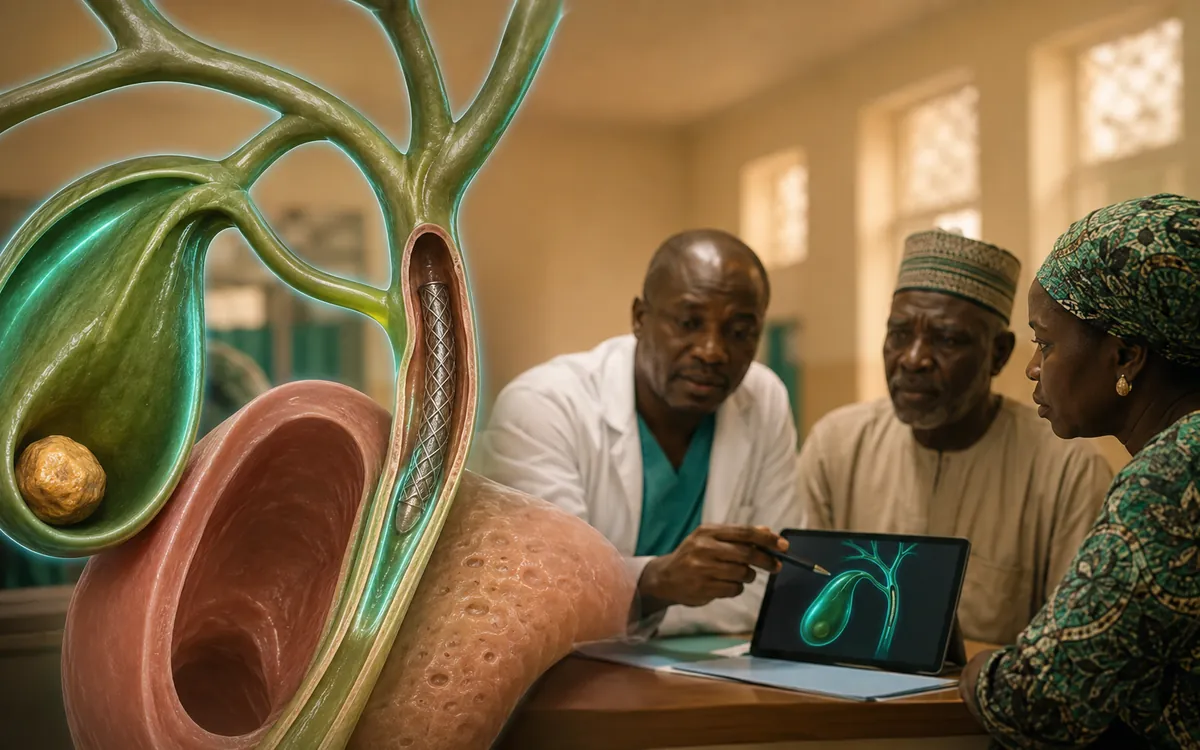
The eyes usually give it away first. Someone notices the whites have turned yellow, then that the urine has darkened and the stools have gone pale. Often there has been severe pain under the right ribs for some time before.
That combination frequently means a stone has lodged in the bile duct. It is a problem that used to require open surgery. Now, in most cases, it does not.
What the bile duct does
Your liver produces bile, which helps digest fat. Bile travels down a narrow channel, the bile duct, into the small intestine, with the gallbladder acting as a storage reservoir along the way.
Gallstones form in the gallbladder. Most sit there causing nothing. Trouble starts when one escapes into the bile duct and gets stuck. Bile can no longer drain, pressure builds back toward the liver, and bilirubin, the pigment in bile, spills into the blood. That is what turns the eyes and skin yellow.
The warning signs
- Yellow eyes or skin, usually noticed in the eyes first
- Severe pain in the upper right abdomen, often after fatty food, sometimes radiating to the back or right shoulder
- Dark urine, the colour of strong tea
- Pale, clay-coloured stools
- Itching of the skin, which can be intense
- Fever and chills
Jaundice with fever is the combination to take most seriously. It can mean cholangitis, an infection in the blocked duct, which needs urgent hospital assessment rather than an appointment next week.
How ERCP works
ERCP stands for endoscopic retrograde cholangiopancreatography. The name is a mouthful; the idea is simple.
Under sedation, an endoscope is passed through the mouth, down the stomach, into the first part of the small intestine, to the small opening where the bile duct drains. A very fine tube is then passed up into the duct itself. Contrast dye and X-ray imaging show us exactly where the blockage is.
Then we treat it in the same sitting. A small balloon or basket draws the stone out, and where the duct needs help staying open, a tiny tube called a stent is left in place to let bile drain freely.
No incision. No open surgery. The route in is the one you already have.
Before and after
ERCP is more involved than a standard gastroscopy, so preparation is more thorough. You will usually have blood tests and a scan first, an ultrasound or MRCP, to confirm the diagnosis and plan the procedure. You will be fasted, and usually admitted rather than treated as a walk-in.
Afterwards you are observed for a period, because ERCP carries a small risk of inflaming the pancreas, and that observation matters. Most people go home after a short stay, with the jaundice settling over the following days as bile begins to drain again.
Why it is done in a teaching hospital
ERCP is a specialised procedure. It is best done where surgery, interventional radiology and inpatient care are available on the same campus if a case turns out to be complex. Our unit sits within LASUTH for exactly this reason: the wider hospital is behind the procedure, not across town from it.
What to do if this sounds like you
If your eyes or skin have turned yellow, do not wait to see whether it settles. If there is fever with it, treat that as urgent and attend hospital.
Jaundice always has a cause, and finding it quickly matters. Call the unit on 070 7056 6272 or send a WhatsApp message and we will advise on the fastest route to being seen.
Common questions
What is an ERCP?
ERCP is an endoscopic procedure that reaches the bile and pancreatic ducts through the digestive tract, allowing stones to be removed or a stent placed to relieve a blockage, without open surgery.
Why do the eyes turn yellow with gallstones?
When a stone blocks the bile duct, bile cannot drain into the gut. Bilirubin builds up in the blood and stains the eyes and skin yellow, with dark urine and pale stools.
Is jaundice with fever an emergency?
Yes. Jaundice with fever and upper abdominal pain can indicate cholangitis, an infection of the blocked bile duct, which needs urgent hospital assessment.
Your next step
This information supports a conversation with your clinician; it does not diagnose your symptoms. Request an appointment online, choose help deciding if you are unsure, or call +234 707 056 6272, message +234 707 056 6272 on WhatsApp, or ask your doctor to send a referral to zendaleendoscopy@gmail.com.

Blood in the stool: what to notice, when to get help and what to tell your doctor
A practical guide to describing bleeding clearly and getting the right level of help, without assuming the cause.

Before your endoscopy: the questions that make preparation clearer
From medicines and transport to fees and results, a useful conversation begins before procedure day.
Your endoscopy report and biopsy results: understanding the next conversation
The examination, the written report and a laboratory result may arrive at different times. Here is how to keep the next steps clear.