
Barrett's oesophagus
Barrett's oesophagus is a change in the lining of the food pipe caused by years of acid reflux. It is not cancer, and most people with it never develop cancer, but it is worth knowing about and monitoring.
Also known as: Barrett's oesophagus · Barrett oesophagus · Columnar-lined oesophagus
Understanding barrett's oesophagus
What Barrett's oesophagus is
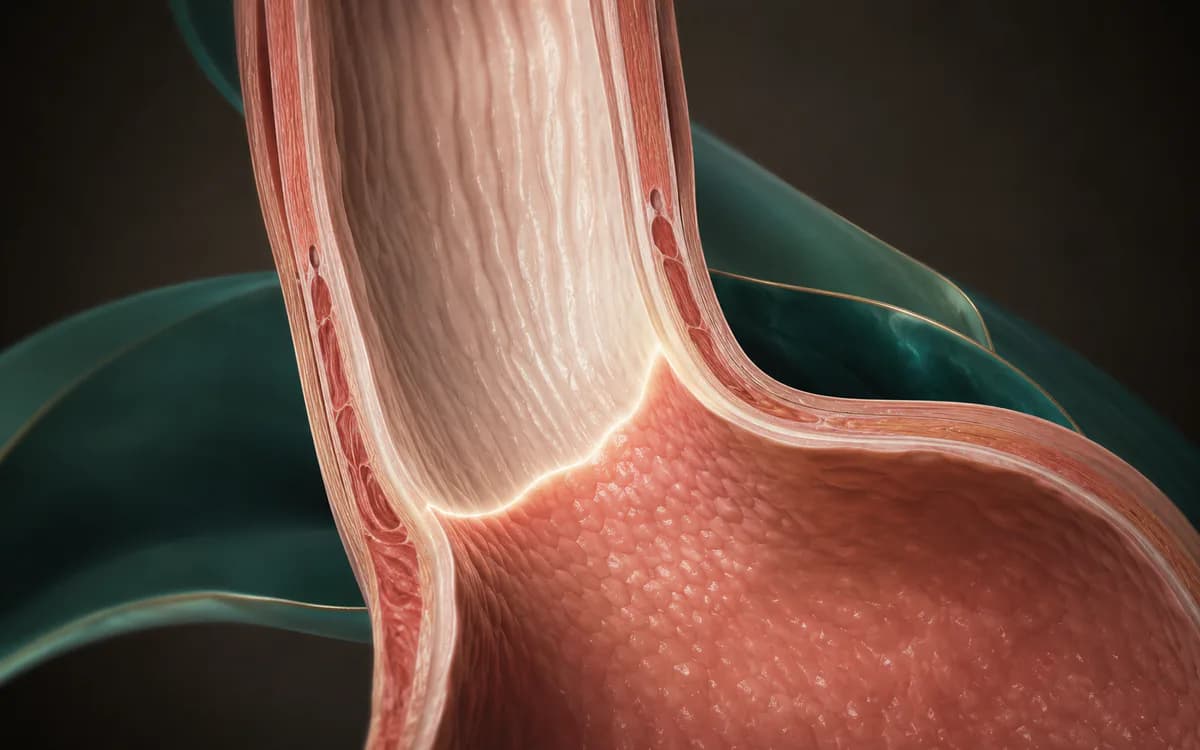
The oesophagus is normally lined with flat, pale cells that are not built to withstand acid. After years of repeated reflux, the lining in the lower oesophagus can adapt, replacing itself with a more robust, intestine-like lining. That adaptation is Barrett's oesophagus.
In one sense it is the body protecting itself, because the new lining tolerates acid better. The trade-off is that this altered tissue carries a small risk of further change over time.
Understanding barrett's oesophagus
Who develops it
Barrett's is strongly linked to long-standing reflux. Risk is higher with:
- Reflux symptoms lasting more than five years
- Being male, and being over 50
- Carrying excess weight around the abdomen
- Smoking
- A family history of Barrett's or oesophageal cancer
Understanding barrett's oesophagus
Symptoms
Barrett's itself causes no symptoms. People are diagnosed because they had an endoscopy for reflux, not because the Barrett's announced itself.
Somewhat confusingly, some people find their heartburn improves as Barrett's develops, because the new lining is less sensitive to acid. Improving symptoms therefore do not mean the reflux has resolved.
Understanding barrett's oesophagus
The real level of risk
This is where reassurance matters, because the diagnosis frightens people more than the facts warrant.
Barrett's oesophagus is not cancer. The great majority of people who have it will never develop oesophageal cancer, and the annual risk of progression is low. What Barrett's does is identify a group worth keeping an eye on, which is a good position to be in rather than a frightening one.
Risk rises if biopsies show changes called dysplasia, where the cells are beginning to behave abnormally. Dysplasia is graded low or high, and both are treatable, which is exactly the point of finding them early.
Understanding barrett's oesophagus
Diagnosis and surveillance
Barrett's is diagnosed at gastroscopy. The altered lining has a distinctive appearance, and biopsies confirm it and check for dysplasia.
If confirmed, you enter a surveillance programme: a repeat gastroscopy at intervals determined by the length of the affected segment and whether any dysplasia was found. For non-dysplastic Barrett's the interval is typically a few years; where dysplasia is present, it is much shorter.
Surveillance is not a formality. It is the mechanism by which a treatable change is caught before it becomes a serious one.
Understanding barrett's oesophagus
Treatment
For Barrett's without dysplasia, treatment focuses on controlling the reflux that caused it, usually with long-term acid-reducing medication and the same weight, diet and smoking measures that help reflux generally, plus regular surveillance.
Where dysplasia is present, the abnormal tissue can be treated endoscopically, by removing it or by ablation techniques that destroy the altered lining and allow normal tissue to regrow. These are done through the endoscope rather than by open surgery, and are highly effective when the change is caught early.
Common questions
Is Barrett's oesophagus cancer?
No. It is a change in the lining of the oesophagus caused by acid reflux. Most people with Barrett's never develop cancer, but it does warrant monitoring.
How often do I need surveillance endoscopy?
It depends on the length of the affected segment and whether dysplasia is present. Typically every few years without dysplasia, and much more frequently if dysplasia is found.
Can Barrett's oesophagus be reversed?
Controlling reflux prevents progression, and where dysplasia is present endoscopic treatment can remove or destroy the abnormal lining so normal tissue regrows.
Acid reflux and GERD
Occasional heartburn is normal. Reflux that returns the moment you stop medication, or has run for years, is worth examining rather than medicating indefinitely.
Peptic ulcers
Stress and pepper get the blame for ulcers in Nigeria. The real causes are H. pylori infection and anti-inflammatory painkillers, and both are treatable once identified.
H. pylori infection
H. pylori is a bacterium carried by a large share of Nigerian adults. Most never know. In others it causes ulcers, chronic gastritis and years of unexplained stomach pain.
Talk to the unit
This page is general information, not a diagnosis. If it describes you, a short consultation decides what, if anything, you need. Call +234 707 056 6272 or message +234 707 056 6272 on WhatsApp.