
Difficulty swallowing
Most gut symptoms can be watched for a couple of weeks. This is one of the few we ask people not to wait on, because the serious causes are far easier to treat early.
Also known as: Dysphagia · Food sticking · Trouble swallowing
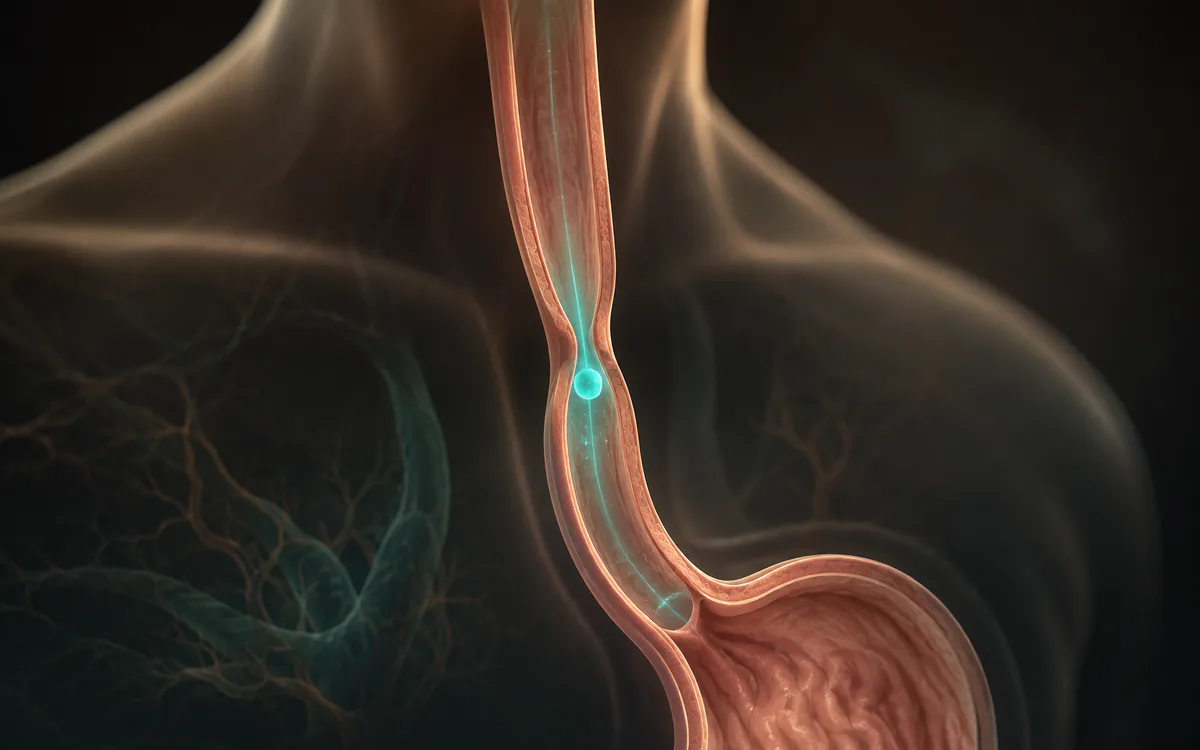
Understanding difficulty swallowing
What dysphagia means
Dysphagia is the medical term for difficulty moving food or drink from the mouth to the stomach. It is a symptom, not a diagnosis, and the pattern tells us a great deal about the cause.
Doctors separate it into two broad types. Oropharyngeal dysphagia is trouble starting a swallow, often with coughing or choking, and usually relates to the muscles and nerves of the throat. Oesophageal dysphagia is the sensation of food sticking after the swallow has begun, typically felt behind the breastbone, and is what we most often investigate by endoscopy.
Understanding difficulty swallowing
The pattern matters
One question separates most causes: is it worse with solids, with liquids, or with both?
Difficulty with solids alone, gradually worsening over weeks or months, suggests a physical narrowing of the oesophagus. Difficulty with both solids and liquids from the outset points more toward a problem with how the oesophagus moves food along. Intermittent sticking that comes and goes over years is more typical of a ring or a motility disorder than of a growth.
Understanding difficulty swallowing
Causes
The range runs from entirely benign to serious, which is exactly why it needs examining rather than guessing:
- A peptic stricture, where long-standing acid reflux scars and narrows the lower oesophagus
- Eosinophilic oesophagitis, an allergy-driven inflammation increasingly recognised in younger patients
- A Schatzki ring, a thin band of tissue causing intermittent sticking with solids
- Achalasia, where the valve into the stomach fails to relax and the oesophagus loses its coordinated squeeze
- Oesophageal cancer, which typically causes steadily progressive difficulty with solids and weight loss
- Compression from outside the oesophagus, for example an enlarged thyroid or a chest mass
- Stroke and neurological conditions, which more often cause the throat-type difficulty with coughing
Understanding difficulty swallowing
Why we ask you not to wait
Most causes turn out to be manageable, and many are treatable during the same endoscopy that diagnoses them.
The reason for urgency is the minority: oesophageal cancer frequently presents first as difficulty swallowing solids. Caught early it is far more treatable than when it presents late, and in our experience the difference between those two situations is often only months of waiting.
People adapt to this symptom remarkably well, chewing longer, choosing softer food, drinking more water with meals. That adaptation is precisely what delays diagnosis.
Understanding difficulty swallowing
How we investigate it
A gastroscopy is usually the first and most useful test. Under sedation we see the oesophagus directly, identify a narrowing, inflamed lining or growth, and take biopsies painlessly.
Crucially, we can often treat at the same visit. A benign stricture or ring can be gently dilated during the procedure, frequently relieving symptoms immediately.
Where the endoscopy is normal but symptoms persist, further tests such as a barium swallow or oesophageal manometry assess how the muscle is working.
Understanding difficulty swallowing
Treatment
Treatment follows the cause. Acid-related strictures are dilated and then managed with acid-reducing medication to stop them recurring. Eosinophilic oesophagitis responds to dietary changes and topical steroid treatment. Achalasia is treated by procedures that release the tight valve. Where a growth is found, we move quickly into the right specialist pathway, with surgery, oncology and radiology on the same LASUTH campus.
Common questions
Is difficulty swallowing serious?
It can be. Difficulty that is new, persistent or worsening, particularly with weight loss, should be investigated without delay, even though many causes turn out to be manageable.
What test is used for difficulty swallowing?
A gastroscopy is usually first, because it allows us to look and treat at the same time. Further tests assess muscle function if the endoscopy is normal.
Can a narrowing be treated during the endoscopy?
Often yes. Benign strictures and rings can be gently stretched during the same procedure, which frequently relieves symptoms straight away.
Acid reflux and GERD
Occasional heartburn is normal. Reflux that returns the moment you stop medication, or has run for years, is worth examining rather than medicating indefinitely.
Peptic ulcers
Stress and pepper get the blame for ulcers in Nigeria. The real causes are H. pylori infection and anti-inflammatory painkillers, and both are treatable once identified.
H. pylori infection
H. pylori is a bacterium carried by a large share of Nigerian adults. Most never know. In others it causes ulcers, chronic gastritis and years of unexplained stomach pain.
Talk to the unit
This page is general information, not a diagnosis. If it describes you, a short consultation decides what, if anything, you need. Call +234 707 056 6272 or message +234 707 056 6272 on WhatsApp.