
Gallstones and jaundice
When a gallstone escapes into the bile duct and lodges there, bile cannot drain. The eyes turn yellow, the urine darkens and the pain can be severe. ERCP clears it without open surgery.
Also known as: Bile duct stones · Obstructive jaundice · Yellow eyes · Choledocholithiasis
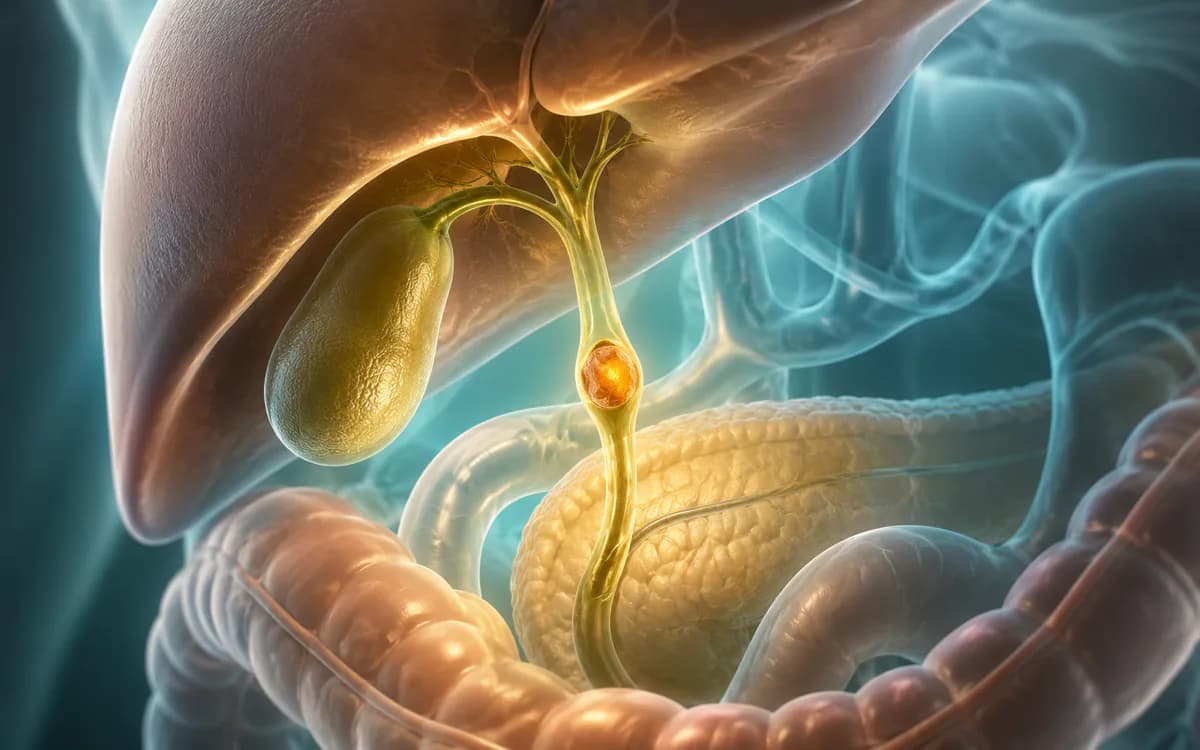
Understanding gallstones and jaundice
How the system works
The liver continuously produces bile, which helps digest fat. Bile drains through a network of fine channels into the common bile duct and then into the small intestine. The gallbladder sits alongside as a storage reservoir, squeezing bile out when you eat a fatty meal.
Gallstones form in the gallbladder, usually from cholesterol or bile pigments. Most sit there silently for years and never cause a problem. Trouble begins when a stone moves.
Understanding gallstones and jaundice
What goes wrong
A stone blocking the neck of the gallbladder causes biliary colic: intense pain in the upper right abdomen, often after a fatty meal, sometimes radiating to the back or right shoulder blade. If it stays stuck and the gallbladder becomes inflamed and infected, that is cholecystitis.
A stone that escapes into the common bile duct is the situation that produces jaundice. Bile cannot drain, pressure builds back toward the liver, and bilirubin spills into the bloodstream, staining the eyes and skin yellow, darkening the urine and leaving the stools pale.
If bacteria then infect that stagnant, obstructed duct, the result is cholangitis, a genuine emergency. The classic triad is jaundice, fever with chills, and upper abdominal pain.
Understanding gallstones and jaundice
Other causes of jaundice
Not all jaundice is gallstones, and the distinction matters. Jaundice broadly falls into three groups: excess breakdown of red cells, liver disease such as hepatitis, and obstruction of the bile ducts.
Obstructive jaundice, the type ERCP treats, characteristically comes with dark urine and pale stools, because bile is not reaching the gut. Painless jaundice with weight loss in an older patient raises concern about a tumour of the pancreas or bile duct, and needs prompt assessment rather than watchful waiting.
Understanding gallstones and jaundice
How it is assessed
Blood tests show the pattern of liver enzymes and the bilirubin level, which indicate whether the problem is obstructive. An ultrasound is usually first, showing gallstones and any dilated ducts.
Where a duct stone is suspected but not clearly seen, an MRCP, a specialised MRI of the biliary tree, gives a detailed map without any instrumentation. That guides whether ERCP is needed, since ERCP is now used mainly as a treatment rather than purely as a test.
Understanding gallstones and jaundice
How ERCP treats it
Under sedation, an endoscope is passed through the mouth and stomach to the point where the bile duct drains into the small intestine. A fine catheter is guided into the duct itself, and contrast with X-ray imaging shows exactly where the blockage sits.
The opening is then widened, and the stone is drawn out with a balloon or a wire basket. Where the duct needs help staying open, a small stent is placed so bile can drain freely again. There is no incision, because the route in is the one you already have.
ERCP requires a period of observation afterwards, because it carries a small risk of inflaming the pancreas. Most patients go home after a short stay, with the jaundice settling over the following days.
Understanding gallstones and jaundice
What happens next
Clearing the duct solves the immediate problem but not its source. If the gallbladder still contains stones, they can escape again, so removal of the gallbladder is usually recommended afterwards, planned with the surgical team.
Being inside LASUTH matters here: surgery, radiology and inpatient care are on the same campus, so a case that needs more than an endoscopy does not become a referral across the city.
Common questions
Is jaundice with fever an emergency?
Yes. Jaundice with fever and upper abdominal pain can indicate cholangitis, an infection of the obstructed bile duct, which requires urgent hospital assessment.
Is ERCP major surgery?
No. It is an endoscopic procedure performed through the digestive tract under sedation, with no incision, though it does require observation afterwards.
Will I still need my gallbladder removed?
Usually yes. ERCP clears the duct, but if the gallbladder still holds stones they can escape again, so removal is generally recommended afterwards.
Why are my stools pale and urine dark?
Because bile is not reaching the intestine. Bile gives stool its normal colour, and the excess bilirubin is excreted by the kidneys instead, darkening the urine.
Talk to the unit
This page is general information, not a diagnosis. If it describes you, a short consultation decides what, if anything, you need. Call +234 707 056 6272 or message +234 707 056 6272 on WhatsApp.