
Inflammatory bowel disease
Crohn's disease and ulcerative colitis are chronic inflammatory conditions of the digestive tract. They are diagnosed by endoscopy and biopsy, and modern treatment controls them well.
Also known as: IBD · Crohn's disease · Ulcerative colitis
Understanding inflammatory bowel disease
What IBD is
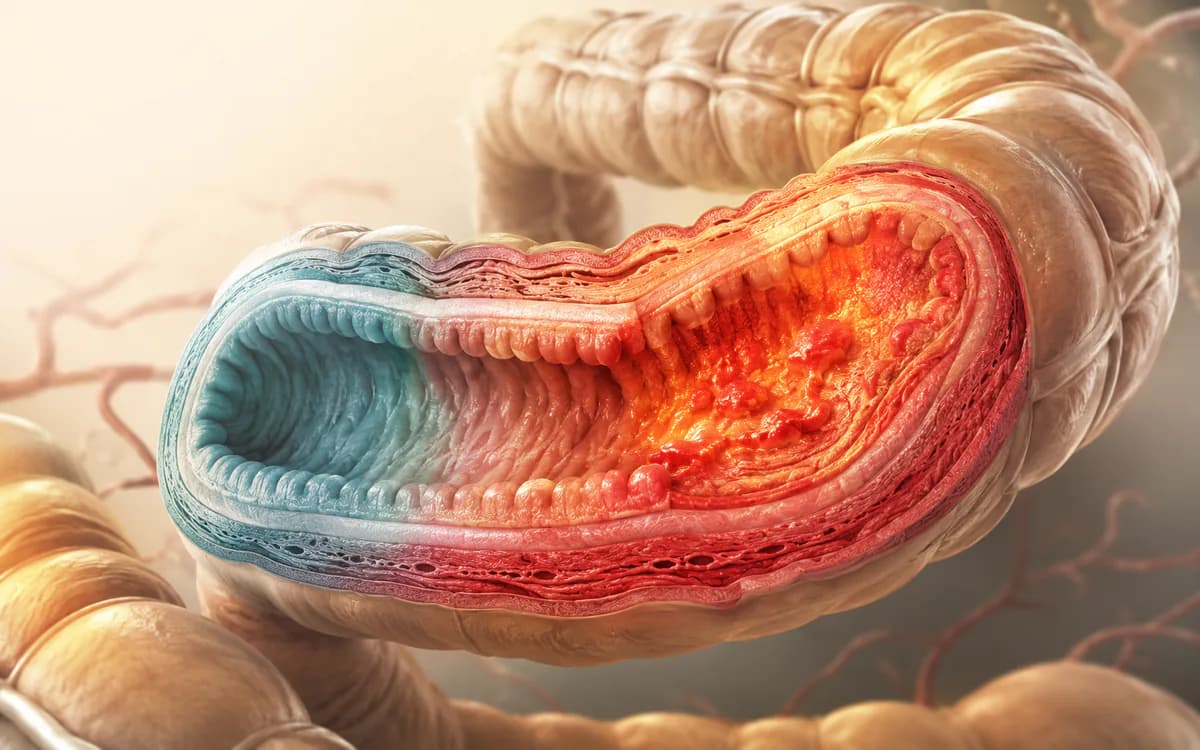
Inflammatory bowel disease describes chronic inflammation of the digestive tract driven by an inappropriate immune response in genetically susceptible people. It is distinct from irritable bowel syndrome, which involves no inflammation and no tissue damage.
It is often assumed to be rare in Africa. It is being diagnosed with increasing frequency in Nigeria, and part of that is genuinely rising incidence and part is better recognition. It is under-diagnosed here, and often mistaken for chronic infection.
Understanding inflammatory bowel disease
Crohn's disease and ulcerative colitis
Ulcerative colitis affects the large bowel only, starting at the rectum and extending continuously for a variable distance. Inflammation is confined to the innermost lining. The dominant symptoms are bloody diarrhoea, urgency and a frequent sense of incomplete emptying.
Crohn's disease can affect any part of the digestive tract from mouth to anus, most commonly the end of the small bowel and the beginning of the colon. It skips areas, leaving normal segments between inflamed ones, and it involves the full thickness of the wall. That depth is why Crohn's can cause narrowing, abscesses and fistulas.
Understanding inflammatory bowel disease
Symptoms
Both conditions cause a similar core group of symptoms, with differences in emphasis:
- Diarrhoea persisting for weeks, often with blood or mucus in ulcerative colitis
- Abdominal pain, cramping more typically in Crohn's
- Urgency, and waking at night to open the bowels
- Weight loss and reduced appetite
- Fatigue, frequently from anaemia
- Fever during flares
- Symptoms outside the gut: joint pains, mouth ulcers, eye inflammation, skin rashes
Understanding inflammatory bowel disease
How it is diagnosed
Diagnosis rests on colonoscopy with biopsies. The endoscopic appearance suggests the diagnosis, and the microscopic examination of the tissue confirms it and helps distinguish Crohn's from ulcerative colitis.
Blood tests assess inflammation and anaemia, and a stool calprotectin test is a useful way to separate inflammatory disease from IBS before proceeding. Stool cultures exclude infection, which is essential in Nigeria where chronic infective causes of diarrhoea must be considered and excluded first.
Where Crohn's is suspected, imaging of the small bowel completes the picture, since a colonoscope cannot reach most of it.
Understanding inflammatory bowel disease
Treatment
Treatment aims to bring a flare under control and then keep the disease in remission long term, ideally with healing of the lining rather than just relief of symptoms.
Options range from anti-inflammatory drugs such as mesalazine in ulcerative colitis, through steroids for flares, to immunosuppressants and biologic therapies for more severe or resistant disease. Nutrition matters throughout, and correcting iron and vitamin deficiencies is part of care rather than an afterthought.
Surgery is needed in a minority, for complications such as strictures, fistulas or disease that does not respond to medication.
Understanding inflammatory bowel disease
Living with IBD, and surveillance
Most people with IBD, well treated, live full and active lives with long periods of remission. Staying on maintenance treatment during good spells is what keeps those spells long.
Long-standing colitis carries an increased risk of bowel cancer, so surveillance colonoscopy begins after around eight to ten years of disease and continues at intervals based on the extent and severity of inflammation. This is a routine, planned part of care.
Common questions
What is the difference between IBS and IBD?
IBS is a disorder of gut function with no inflammation and no tissue damage. IBD involves genuine inflammation that damages the bowel wall, is visible at endoscopy, and requires long-term treatment.
Is IBD common in Nigeria?
It was long thought rare, but it is diagnosed increasingly often and is under-recognised. Chronic diarrhoea lasting weeks should not be assumed to be infection without proper assessment.
Can IBD be cured?
It is controlled rather than cured. Modern treatment achieves long remission for most people, and removal of the colon can be curative in ulcerative colitis specifically.
Rectal bleeding and piles
Most rectal bleeding is piles. The danger is assuming every bleed is piles, because the exceptions are exactly the cases where waiting costs the most.
Bowel cancer
Colorectal cancer is rising in Nigeria and patients are presenting younger. It is also one of the most preventable cancers there is, provided you look before symptoms appear.
Bowel polyps
A polyp is a small growth on the bowel wall. Most are harmless, but some are the seed from which bowel cancer grows, which is why we remove them when we find them.
Talk to the unit
This page is general information, not a diagnosis. If it describes you, a short consultation decides what, if anything, you need. Call +234 707 056 6272 or message +234 707 056 6272 on WhatsApp.